Federweisser and Onion Tart: Origin and Special Characteristics
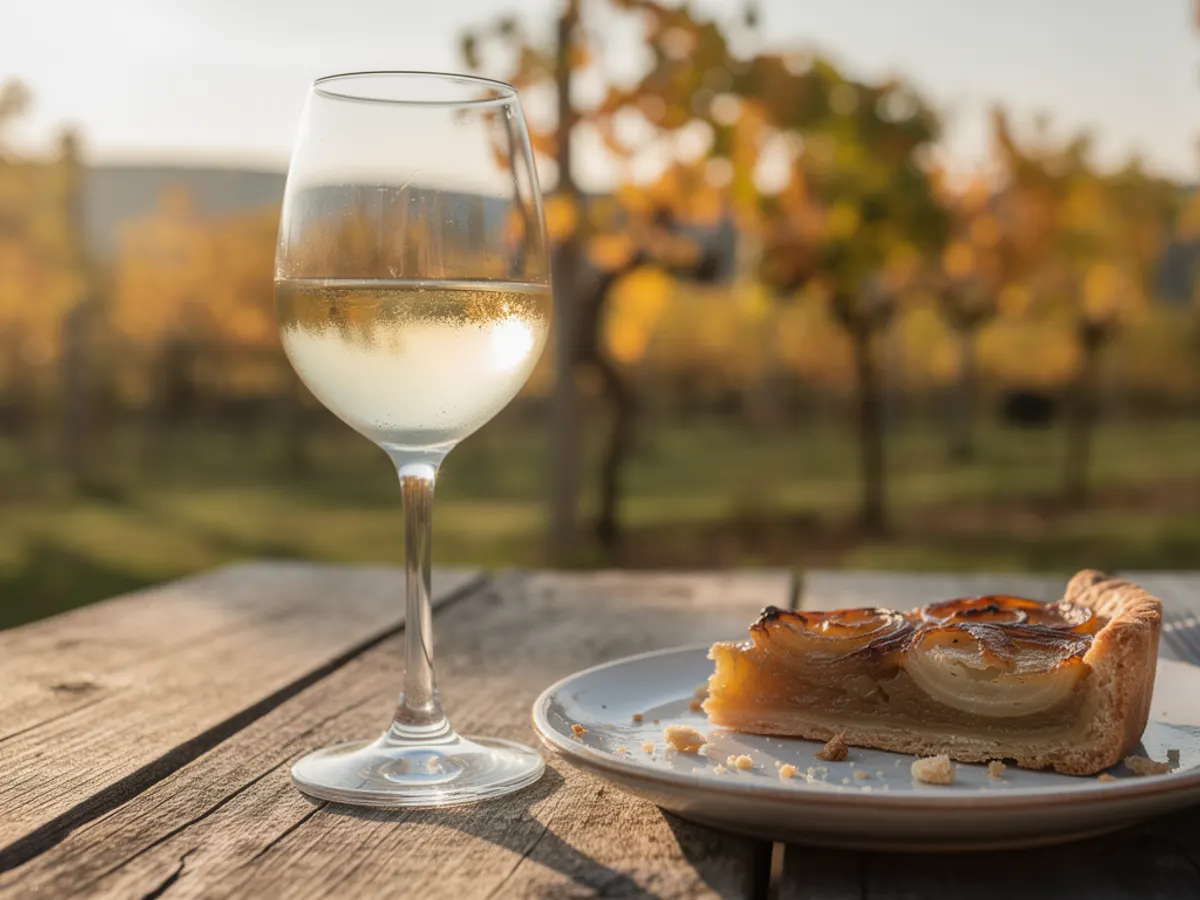
In German wine regions, partially fermented grape must is traditionally served with savory baked goods.
KW
In German wine regions, partially fermented grape must is traditionally served with savory baked goods.
 Illustration
In early fall, the sale of Federweisser begins in the wine-growing regions. This is grape must that is in the middle of the fermentation process. The beverage owes its name to the yeast cells that are visible in the glass as light suspended particles.
Because fermentation continuously produces carbon dioxide, bottles of Federweisser must not be sealed airtight. The caps have small openings through which the resulting carbon dioxide can escape. The containers must therefore always be transported and stored upright.
The taste of the drink changes during storage. At first, the high sugar content of the grapes dominates, giving the must a sweet taste. As time goes on, the yeasts convert the sugar into alcohol, making the Federweisser increasingly dry and tart.
Traditionally, Federweisser is served with warm onion tart. The tart usually consists of a yeast or shortcrust dough topped with sautéed onions, sour cream or creme fraiche, eggs, and bacon.
The combination of the acidity of the must and the salty taste of the onion tart is widespread in growing regions such as Rheinhessen, the Palatinate, and Baden. Caraway seeds are often added to the onion topping to make the dish easier to digest.
We use strictly necessary storage to run this site. Analytics and advertising cookies are only set with your consent. Cookie Policy
Choose which optional cookies you allow. You can change your choice at any time.
Stores your choice and keeps the site working.
Anonymous statistics on which pages are read.
Lets partners show and measure ads.